Anterior Cruciate Ligament (ACL) Reconstruction
Patient information — Dr Christopher Spelman, Orthopaedic Surgeon
Overview
The anterior cruciate ligament (ACL) is one of the main stabilising ligaments of the knee. It runs through the centre of the joint and prevents the shin bone (tibia) from sliding forward and rotating abnormally on the thigh bone (femur). ACL tears commonly occur during sports that involve pivoting, sidestepping or landing, and are frequently associated with a “pop”, rapid swelling and a feeling that the knee has given way.
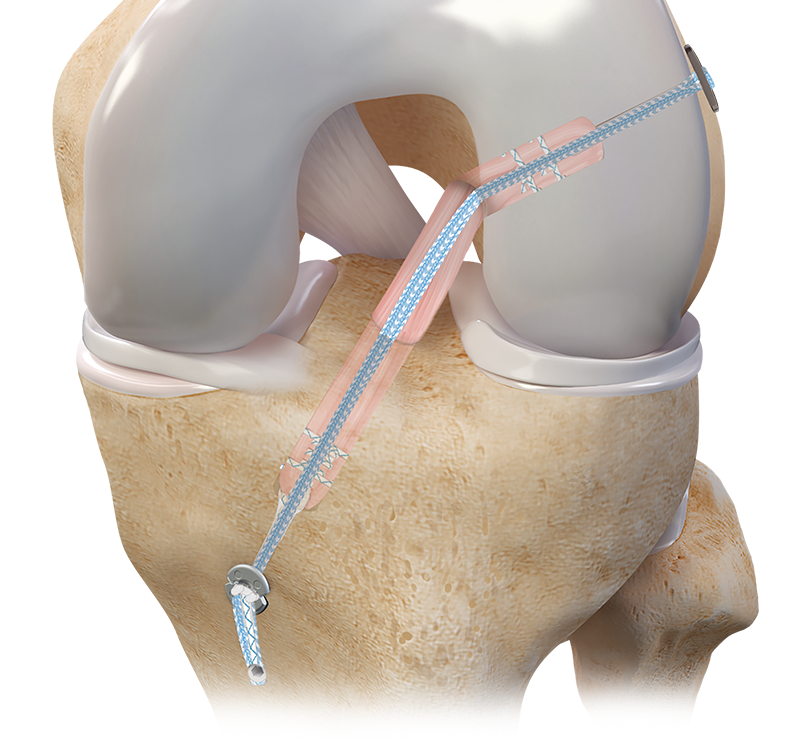
ACL reconstruction is an operation to replace the torn ligament with a graft, restoring stability to the knee. The torn ligament cannot simply be stitched back together, so it is reconstructed using a tendon graft that is passed through bone tunnels drilled in the femur and tibia and fixed in place. The graft acts as a scaffold for a new ligament to grow. The surgery is performed arthroscopically (keyhole).
Do all ACL tears need surgery
Not every ACL tear requires reconstruction. Some patients, particularly those who are less active or who do not experience instability, can be managed successfully with physiotherapy and activity modification. Reconstruction is generally recommended for patients who wish to return to pivoting sports, who have ongoing instability, or who have associated meniscal or cartilage injuries that need to be protected.
Graft options
There is no single “best” graft for everyone. Dr Spelman will discuss which option suits you based on your age, activity, sport, body type, any previous surgery and your own preferences. Grafts fall into two broad categories – autograft (tissue taken from your own body) and allograft (donor tissue). For most young, active patients an autograft is preferred, as donor tissue (allograft) has consistently higher failure rates in this group. The main options are:
Hamstring tendon autograft – tendons taken from the inner thigh. Widely used, with a small incision and generally less pain at the front of the knee. Possible downsides include mild hamstring weakness and a small area of numbness on the outer shin.
Bone–patellar tendon–bone (BPTB) autograft – the central third of the tendon below the kneecap, taken with a small block of bone at each end. Provides very secure bone-to-bone healing and is often favoured for high-demand pivoting athletes. Possible downsides include pain at the front of the knee and discomfort when kneeling.
Quadriceps tendon autograft – tendon taken from above the kneecap. An increasingly used option with good strength and low donor-site pain. Can result in some long term quadriceps weakness according to recent studies.
Allograft (donor tissue) – avoids donor-site problems and may suit older or lower-demand patients or complex revision cases, but carries a higher re-rupture rate in young, active patients and is generally avoided in this group.
What the evidence shows on graft choice
A 2025 systematic review and meta-analysis comparing the two most common autografts found similar rates of return to sport and broadly comparable graft-failure rates, with re-rupture of approximately 3% for bone–patellar tendon–bone and 4% for hamstring grafts. In higher-risk patients, some studies favour patellar tendon or quadriceps grafts for a lower re-rupture rate, while hamstring grafts avoid pain at the front of the knee. The most important message is that graft choice is individualised, and all of the common autografts produce good results in appropriately selected patients.
Recovery and rehabilitation
Rehabilitation is a critical part of ACL reconstruction and typically takes nine to twelve months before return to pivoting sport. A structured, criterion-based program focused on restoring range of motion, quadriceps strength and neuromuscular control gives the best outcomes. Progression to running, agility and sport is based on meeting strength and functional targets rather than time alone. Returning to sport too early markedly increases the risk of a further ACL injury – athletes who return to knee-strenuous sport before nine months have been shown to have around a seven-fold higher rate of a second ACL injury.
Surgical outcomes
ACL reconstruction reliably restores knee stability and allows most patients to return to their previous activities. A systematic review and meta-analysis found that around 83% of elite athletes returned to their pre-injury level of sport after reconstruction, with a graft rupture rate of about 5%; most athletes who returned performed comparably with uninjured team-mates. Patient-reported outcomes are generally good, and reconstruction protects the meniscus and cartilage from the repeated damage caused by an unstable knee. Outcomes depend heavily on the quality and completion of rehabilitation.
Re-injury and revision rates
Although most reconstructions are successful, a proportion of grafts fail or a further ACL injury occurs, and this risk is highest in young athletes returning to pivoting sport. Key figures from the published evidence include:
Overall re-rupture (graft failure) rates are commonly in the range of 3–10%, varying with graft type, age and activity.
The overall second ACL injury rate (either knee) is around 15%. This rises to approximately 21% in patients under 25, and around 23% in athletes under 25 who return to sport.
The risk applies to both knees – after reconstruction there is a comparable risk of injuring the ACL in the opposite (previously uninjured) knee.
The highest risk period is within the first two years after surgery, and early return to sport is a major modifiable risk factor.
If a graft fails, a revision (redo) reconstruction can be performed, but outcomes are generally less predictable than for a first reconstruction. The Multicenter ACL Revision Study (MARS) reported around an 18% graft-failure rate at a minimum of ten years, and found revision with the patient’s own tissue (autograft) was about 2.8 times less likely to fail than donor tissue (allograft).
Complications
ACL reconstruction is a common and generally safe operation, and serious complications are uncommon. However, as with any surgery, risks exist and it is important that you understand them. Overall complication rates are reported in the range of about 1–15%, depending on how complications are defined. The main risks include:
Graft failure or re-rupture – the graft can stretch or tear, particularly with an early return to pivoting sport or a further significant injury (see rates above).
Infection – a joint infection is uncommon, occurring in roughly 0.1–1.7% of cases, but is a serious complication that may require antibiotics and further surgery.
Stiffness (arthrofibrosis) – difficulty regaining full movement, especially full straightening, can occur and occasionally requires additional treatment or a further procedure to release scar tissue. Reported rates vary widely; clinically significant stiffness affects a minority of patients.
Blood clots – deep vein thrombosis (DVT) in the leg and, rarely, pulmonary embolism (a clot travelling to the lungs). Symptomatic clots are uncommon after keyhole knee surgery (in the order of 0.5–2%).
Persistent instability or looseness – some knees retain a degree of rotational laxity; in selected high-risk patients an additional procedure (lateral extra-articular tenodesis) can reduce this.
Donor-site symptoms – pain at the front of the knee and discomfort kneeling (more common with patellar tendon grafts), or mild hamstring weakness and a patch of numbness on the outer shin (with hamstring grafts).
Numbness around the scars – a small area of reduced sensation near the incisions is common and usually of no functional consequence.
Hardware irritation – the screws or devices used to fix the graft occasionally cause irritation and are rarely removed.
Growth disturbance – a specific consideration in children and adolescents whose growth plates are still open, which is why growth-plate-protecting techniques are used in this group.
Long-term osteoarthritis – an ACL injury increases the lifetime risk of knee arthritis. Reconstruction restores stability and protects the meniscus, but does not entirely remove this long-term risk, which is influenced by the original injury and any associated meniscal or cartilage damage.
Summary
ACL reconstruction is a reliable operation that restores stability and allows most people to return to sport and active work. The choice of graft is individualised, rehabilitation is central to a good result, and returning to sport too soon is the main avoidable cause of a second injury. While serious complications are uncommon, they are important to understand. Dr Spelman will discuss your specific injury, the most suitable graft and the risks and benefits with you before any decision is made.