How long will my hip replacement last?
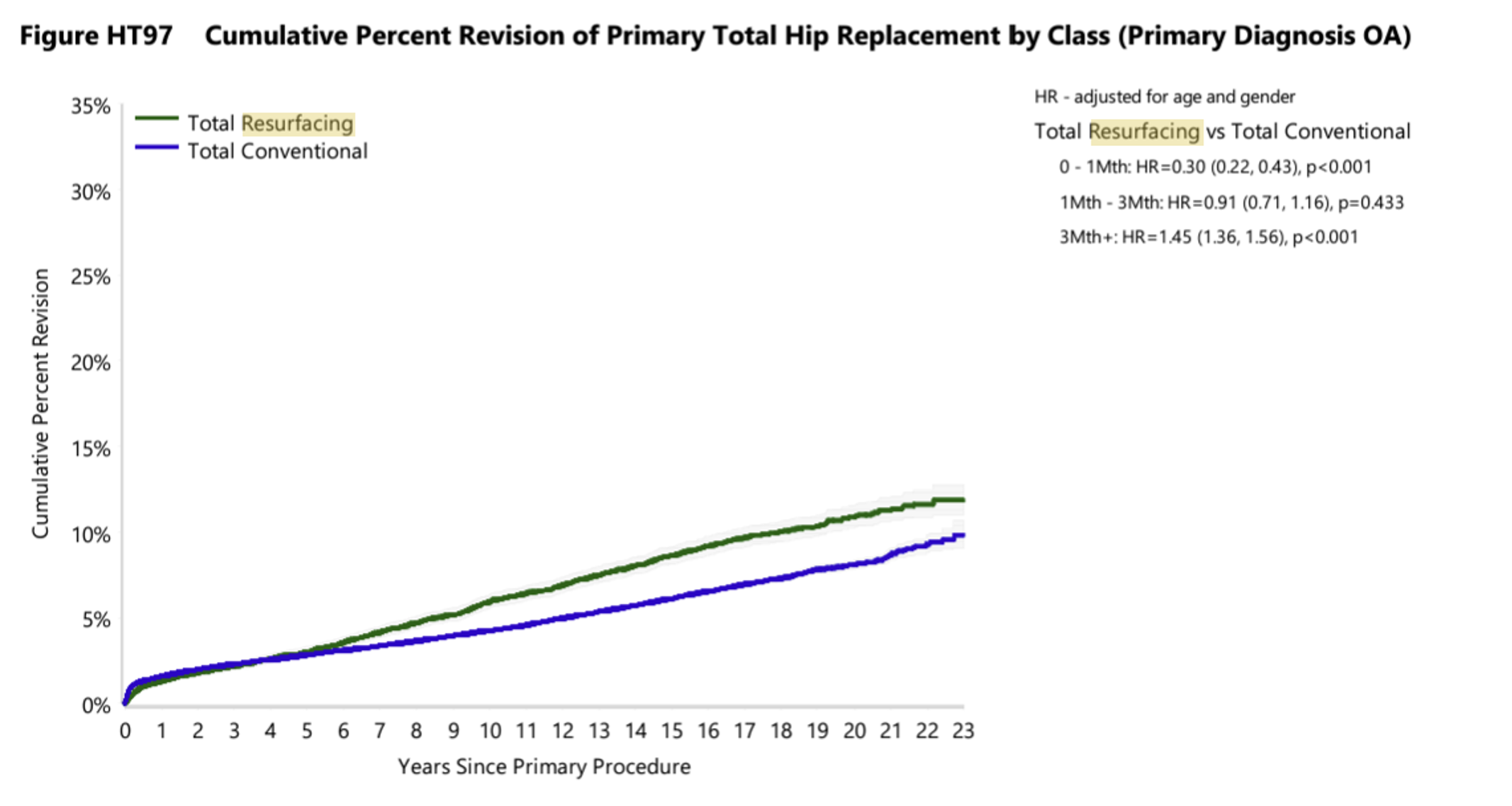
Most modern hip replacements last a very long time. Australian registry data tracks every joint replacement performed in this country, and it shows that the great majority of hip replacements are still functioning well two decades after surgery. The current statistics are roughly 8% of hip replacements will need revising by 20 years.
That said, “how long will it last” is really two questions, and it is worth separating them.
What the registry measures. The Australian Orthopaedic Association National Joint Replacement Registry records every hip and knee replacement performed in Australia and follows them for life. What it reports is the revision rate — the proportion of implants that have needed further surgery. It is one of the most complete datasets of its kind anywhere in the world, which means Australian patients can be given genuinely reliable figures rather than estimates.
Why your figure is not the average figure. Two factors move the number more than anything else:
Age at surgery. Someone who has a hip replacement at 50 has more years ahead in which the implant could fail, and is likely to be more active during them. Revision rates are consistently higher in younger patients. Someone having the same operation at 65 will very often have it for life.
Activity level. Bearing surfaces wear in proportion to use. High-impact activity accelerates that. This is one of the reasons the conversation about running and jumping after joint replacement matters.
What causes a hip replacement to need revision? Loosening of the components from the bone over time, wear of the bearing surface, recurrent dislocation, infection, and fracture of the bone around the implant.
What you can influence. Not much about the implant, but something about the outcome: maintaining a healthy weight reduces the load through the joint; staying active with lower-impact exercise maintains the muscle that protects it; and treating infections anywhere in the body promptly reduces the risk of bacteria seeding the joint. Staying as strong as possible through strength training will improve your long term joint function.
What this means for the decision. For most patients over 65, a hip replacement is likely to be the only one they need. For younger patients, planning on the possibility of a revision at some point is realistic — which is one reason bone-preserving options like hip resurfacing are discussed in that age group.
Dr Spelman will give you the figures relevant to your age, your activity level and the specific implant proposed, rather than a general average.