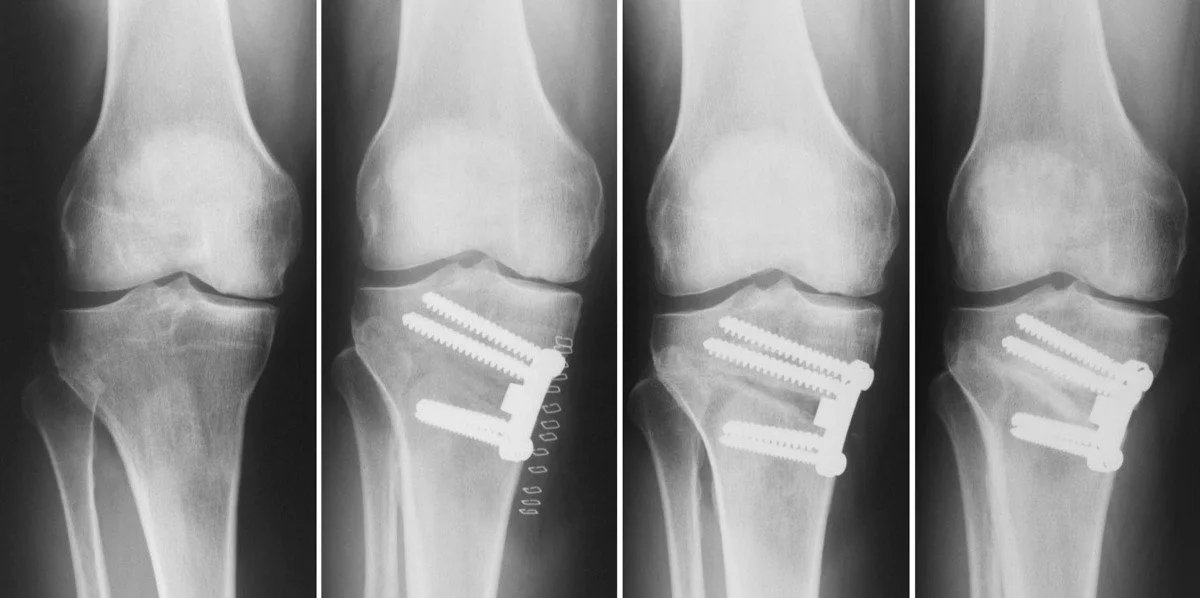
Knee Osteotomy – High Tibial and Distal Femoral
Patient information — Dr Christopher Spelman, Orthopaedic Surgeon
Overview
A knee osteotomy is an operation that realigns the leg to shift weight away from a worn, arthritic part of the knee and onto the healthier side. By offloading the damaged compartment, an osteotomy can relieve pain and slow the progression of arthritis while preserving the patient’s own knee joint. It is particularly valuable in younger, active patients for whom a joint replacement is less ideal because of their age and activity demands.
The two main procedures are the high tibial osteotomy, which realigns the top of the shin bone, and the distal femoral osteotomy, which realigns the lower end of the thigh bone. The choice between them depends on where the deformity lies and which compartment of the knee is worn.
High tibial osteotomy (HTO)
A high tibial osteotomy is used for arthritis of the inner (medial) compartment combined with bow-legged (varus) alignment. A controlled cut is made in the upper shin bone and the alignment corrected – most commonly by opening a wedge on the inner side (medial opening-wedge) and holding it with a plate and screws, or alternatively by removing a wedge from the outer side (lateral closing-wedge). The correction is planned in advance from full-length x-rays.
Distal femoral osteotomy (DFO)
A distal femoral osteotomy is used for arthritis of the outer (lateral) compartment combined with knock-kneed (valgus) alignment. The correction is made at the lower end of the thigh bone, close to where the deformity usually arises, again using a wedge held with a plate and screws. Correcting the alignment at the site of the deformity gives the most reliable result, and both opening- and closing-wedge techniques are used depending on the individual.
Who is suitable
Osteotomy is best suited to patients with arthritis confined to one compartment, reasonable range of motion, good stability and an appropriate body weight, particularly those who are younger and wish to remain active. It preserves the natural knee and allows a return to higher-impact activity than a joint replacement. It is not suitable where arthritis involves several compartments or where the knee is very stiff.
Recovery
Because the bone must heal, recovery is more protracted than for keyhole surgery. A period of protected weight-bearing is usually needed while the osteotomy unites, followed by progressive rehabilitation. Bony healing typically takes around three months, with continued improvement over the following year.
Outcomes and what the evidence shows
For high tibial osteotomy, a systematic review of patients with advanced medial arthritis reported average survivorship (freedom from knee replacement) of approximately 75% at ten years, with good and durable improvements in patient-reported outcomes. A comparison of opening- and closing-wedge techniques found comparable outcomes and ten-year survivorship, with differing complication profiles.
For distal femoral osteotomy, systematic reviews report good functional improvement and ten-year survivorship in the order of 80–85% in appropriately selected younger patients with isolated lateral compartment arthritis. If arthritis eventually progresses, either osteotomy can be converted to a knee replacement.
Complications
Osteotomy is a bigger undertaking than keyhole surgery because it involves cutting and healing bone, and overall complication rates of around 10–15% are reported. Most complications are manageable. The main risks include:
Delayed healing or non-union of the bone – the osteotomy occasionally heals slowly or fails to unite (reported in roughly 1–4%), more likely with larger corrections and in smokers, and sometimes requiring further surgery or bone grafting.
Hardware irritation – the plate and screws are close to the surface and commonly cause irritation; up to about one in five patients later choose to have the metalwork removed once the bone has healed.
Infection – a wound or deep infection occurs in a small percentage of cases (generally under 4% with internal fixation) and may require antibiotics or further surgery.
Blood clots – deep vein thrombosis is one of the more frequent early complications (reported around 5–6%), and the risk is higher in patients aged over 55; measures are taken to reduce this risk.
Loss of, or inaccurate, correction – the alignment can occasionally be under- or over-corrected, or be partly lost before healing.
Fracture into the joint – an unintended fracture line can occur during the osteotomy (more relevant to opening-wedge techniques).
Nerve irritation – irritation of the nerves around the knee can occur, particularly with lateral (outer-side) approaches.
Progression of arthritis and eventual conversion to knee replacement – around 10-20% of high tibial osteotomies are converted to a knee replacement within about five years, though many last considerably longer.
Summary
Knee osteotomy is a joint-preserving alternative to replacement for younger, active patients with arthritis limited to one side of the knee. High tibial osteotomy addresses inner-compartment (bow-legged) arthritis and distal femoral osteotomy addresses outer-compartment (knock-kneed) arthritis. Both can relieve pain, delay or avoid joint replacement, and allow a return to active life, and Dr Spelman will discuss whether you are a suitable candidate.