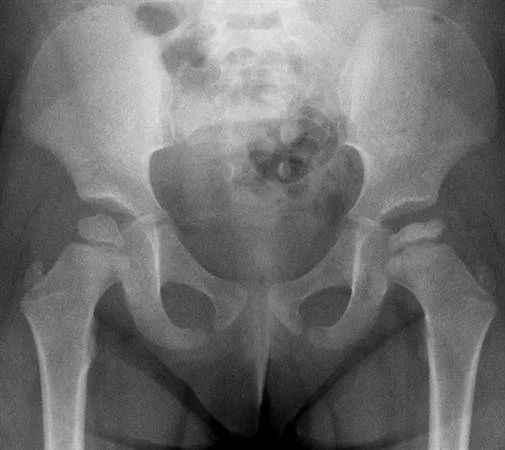
Perthes Disease
Patient information for parents and carers — Dr Christopher Spelman, Orthopaedic Surgeon
What is Perthes disease?
Perthes disease (Legg–Calvé–Perthes disease) is a childhood hip condition in which the blood supply to the ball of the hip (the femoral head) is temporarily disrupted. Part of the bone softens and can lose its round shape; over time the blood supply returns and the bone rebuilds itself, but during this process the femoral head is vulnerable to flattening. It most commonly affects children between about four and eight years of age and is more common in boys.
Symptoms
Perthes disease often causes a limp, which may be painless or associated with aching in the hip, groin, thigh or knee. Symptoms tend to come on gradually and may fluctuate. Children may have reduced movement of the hip, particularly rotation and moving the leg out to the side.
Diagnosis
The diagnosis is made from the history, examination and x-rays. In the early stages an x-ray may appear near-normal, and further imaging such as MRI can be helpful. Because the condition evolves over months to years, children are monitored with periodic x-rays to follow the shape of the femoral head as it heals.
Treatment
The aim of treatment is to keep the femoral head well-seated (“contained”) within the socket so that it remodels into as round a shape as possible. Many younger children with good movement are managed non-operatively, with activity modification, physiotherapy to maintain hip movement, and regular review. In older children, or where the femoral head is at greater risk of deformity, surgery to improve containment (such as an osteotomy of the thigh bone or pelvis) may be recommended.
Outcomes and what the evidence shows
The two factors most consistently shown to determine long-term outcome are the child’s age at onset and the final shape of the femoral head. Younger children (under about six) generally have more remodelling potential and a better prognosis, while children over eight tend to do less well. The shape of the head at maturity strongly predicts arthritis: a well-rounded (spherical) head has a low long-term risk (around 0–16% radiographic arthritis at 40 years), whereas an aspherical, flattened head has a much higher risk (around 58%). Overall, roughly one in five people who had Perthes disease eventually require a hip replacement, typically in mid-adult life, and those replacements generally do well.
Complications
Perthes disease is a condition that runs its course over years, and the main concerns relate to how the femoral head heals:
Permanent deformity of the femoral head – flattening or enlargement of the ball, which is the main driver of long-term problems.
Loss of hip movement and “hinge abduction” – a mis-shapen head can catch against the socket and restrict movement.
Leg-length difference – the affected leg can end up slightly shorter.
Early osteoarthritis – an aspherical head increases the risk of hip arthritis in adult life, sometimes leading to hip replacement.
Surgical risks – where containment surgery is performed, the usual risks of an osteotomy apply, including the need for later removal of metalwork.
Summary
Perthes disease affects the blood supply to the growing hip, and outcome depends mainly on the child’s age and the final shape of the femoral head. Many younger children do well with monitoring and physiotherapy, while some benefit from surgery to keep the hip contained. Careful long-term follow-up allows treatment to be directed to the children most likely to benefit.