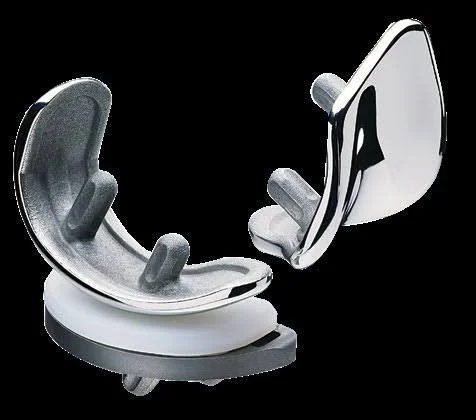
Uni-compartmental Knee Replacement
Patient information — Dr Christopher Spelman, Orthopaedic Surgeon
Overview
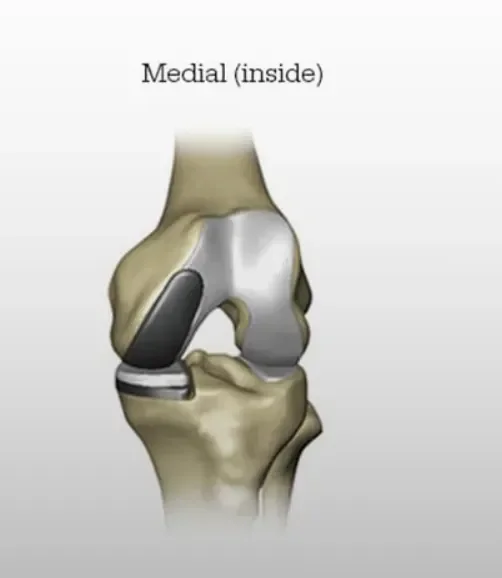
A uni-compartmental (or partial) knee replacement resurfaces only the single compartment of the knee that is worn out, leaving the healthy cartilage, bone and ligaments elsewhere in the knee untouched. The knee has three compartments – the inner (medial), the outer (lateral) and the kneecap (patellofemoral) compartment. When arthritis is confined to just one of these, a partial replacement can relieve pain while preserving more of your natural knee than a total knee replacement.
Who is suitable?
Partial knee replacement is best suited to patients whose arthritis is limited to one compartment, who have reasonable range of motion, and whose knee ligaments (particularly the anterior cruciate ligament) are intact. It is not suitable where arthritis involves more than one compartment or where there is significant deformity or instability. Careful patient selection is the single most important factor in a successful result.
The operation and recovery
The worn surfaces of the affected compartment are removed and replaced with metal and plastic components. Because less bone is removed and the operation is smaller than a total knee replacement, most patients experience a faster early recovery, a more natural-feeling knee and a shorter hospital stay. Most patients walk with aids on the day of surgery or the following day, and return to most daily activities over six to twelve weeks.
Advantages compared with total knee replacement
Compared with a total knee replacement, a partial knee replacement preserves more bone and both cruciate ligaments, tends to feel more like a natural knee, allows a quicker recovery, and is associated with fewer early complications and a lower risk of serious medical complications. These benefits are balanced against a higher long-term rate of further surgery (revision).
Outcomes and what the evidence shows
Modern partial knee replacements provide good long-term results. A systematic review reported approximately 96% survivorship at five years and around 89% at fifteen years, with functional scores reaching roughly 85% of the maximum possible.
Large registry data provide an important balance to this. The Australian Orthopaedic Association National Joint Replacement Registry shows that partial knee replacements have a higher long-term revision rate than total knee replacements – in the order of a 20-year revision rate of around 28% for partial replacements versus about 18% for total replacements – and this rate is higher again in younger patients. Part of this difference reflects the fact that a partial replacement is technically easier to revise, so surgeons and patients may choose revision more readily.
If a partial knee replacement wears out
If a partial replacement fails or arthritis progresses to the other compartments, it can usually be converted to a total knee replacement. Registry data show that the outcome of this conversion is broadly similar to a primary total knee replacement in which both components are being addressed. This is one of the advantages of a partial replacement – it keeps future options open.
Complications
Partial knee replacement is a safe and well-established operation, and serious complications are uncommon. The risks are similar to those of any knee replacement, with some that are specific to the partial procedure:
General surgical risks - Infection, bleeding, damage to nerves or arteries around the knee
Need for further surgery (revision) – the most important long-term consideration; partial replacements are revised more often than total replacements, usually because of loosening or progression of arthritis in the rest of the knee.
Progression of arthritis – wear can develop in the compartments that were left alone, causing ongoing pain and sometimes requiring conversion to a total knee replacement.
Aseptic loosening – the components can loosen from the bone over time in the absence of infection.
Bearing dislocation – in mobile-bearing designs, the plastic insert can occasionally slip out of position and require surgery.
Infection – a deep infection around the implant is uncommon but serious and may require further surgery; partial replacement carries a somewhat lower infection risk than total replacement.
Blood clots – deep vein thrombosis and, rarely, pulmonary embolism; preventive measures are used.
Periprosthetic fracture – a fracture of the bone around the implant, particularly of the tibia, can occur rarely.
Persistent pain – a minority of patients continue to have pain despite a well-positioned implant.
Summary
For patients with arthritis confined to one compartment, a partial knee replacement offers pain relief, a natural-feeling knee and a quicker recovery, at the cost of a higher long-term chance of needing further surgery. Careful patient selection is key, and the decision should be made after discussing the risks and benefits with Dr Spelman.